Recommit to Restraint in U.S. Cluster Munitions Policy
Recent backsliding in U.S. cluster munitions policy implicates international humanitarian law, breaks with longstanding policy and U.S. commitments, and demands an answer from Congress.

By Mina Nur Basmaci and John Ramming Chappell
When Admiral Brad Cooper, commander of U.S. Central Command, condemned Iran’s use of cluster munitions against Israel as “inherently indiscriminate,” he underscored a legal and moral critique long associated with these weapons — one that sits uneasily alongside the Pentagon’s own recent decision to purchase them.
On September 30, 2025, the Department of Defense quietly awarded an indefinite-quantity contract with a ceiling value of $829.1 million to Tomer, an Israeli-government-owned weapons company, for the manufacture, testing, and production of the 155mm High Explosive Advanced Submunition XM1208 projectile: a cluster munition. The contract was not publicly reported until February 2026 and represents the largest recorded weapons procurement by the Department of Defense from Israel.
Then, on December 5, 2025, the Army announced a market survey “to identify potential sources within the United States” for production of the XM1208 projectile, seeking responses from sources capable of consistently producing 30,000 cluster munitions per year. The stated purpose is to “broaden the target set, enhance lethality, and extend the reach of the current cannon platforms beyond the current…capability.”
These recent actions suggest the United States is recommitting to cluster munitions. Although it has not destroyed its existing stockpiles and has transferred cluster munitions to other countries, the U.S. has neither purchased nor itself used cluster munitions for almost two decades. Such a shift implicates international humanitarian law, breaks with longstanding policy and international consensus, and demands an according response from Congress.
Cluster Munitions and International Humanitarian Law
Cluster munitions are explosive weapons that disperse submunitions, or “bomblets,” over broad areas. The XM1208 cluster munition scatters nine submunitions that in turn explode and release around 1,200 tungsten steel fragments. These fragments have been found to disproportionately maim and kill children in Gaza.
By design, cluster munitions are explosive weapons with wide area effects. They saturate broad zones rather than strike discrete targets, making them exceptionally difficult to direct with precision. In practice, their effects often extend far beyond intended military objectives, with devastating consequences for civilians. Cluster munitions are among the deadliest weapons for civilians, who accounted for 91% of recorded casualties from cluster munitions in 2025.

The risks posed by cluster munitions persist long after active hostilities cease. Many submunitions fail to detonate as intended, with dud rates ranging from 2 to 40 percent depending on the system and conditions of use. These unexploded bomblets effectively become landmines, contaminating fields, roads, and residential areas. Their enduring presence renders land unusable, delays reconstruction, prolongs displacement, and poses acute risks to civilians — especially children. The small size of unexploded ordnance and, at times, their brightly colored casings or ribbons, make them particularly attractive to children who can mistake them for toys. Children accounted for 71% of deaths from cluster munition remnants in 2022 where age was recorded.
International humanitarian law (IHL) imposes clear limits on the means and methods of warfare. Central among these is the principle of distinction, which requires parties to a conflict to distinguish between civilians and combatants and between civilian objects and military objectives. The principle reflects both customary international law and U.S. treaty obligations pursuant to the Geneva Conventions. Articles 51 and 52 of Additional Protocol I prohibit directing attacks against civilians and strictly limit lawful targets to objects that make an effective contribution to military action and whose destruction offers a definite military advantage.
Cluster munitions raise serious concerns with respect to distinction. Their effects are typically indiscriminate when used in areas where civilians are present: they disperse submunitions over large areas and often leave behind unexploded ordnance that continues to threaten civilians long after the initial attack. This combination makes it exceedingly difficult—if not impossible in many contexts—to ensure compliance with the rule of distinction. It was this concern that led Adm. Cooper to characterize cluster munitions as “inherently indiscriminate.”
Even where a legitimate military objective is present, the principle of proportionality further constrains attacks. Proportionality does not prohibit incidental civilian harm outright, but it forbids attacks in which the expected civilian harm would be excessive in relation to the anticipated, concrete and direct military advantage. The use of cluster munitions, especially in densely populated areas, complicates compliance as their wide-area effects and high dud rates create foreseeable risks of significant civilian harm both immediately and over time. Indeed, leading human rights organizations regard the use of cluster munitions in a populated area as a violation of IHL.
Experience bears this out. Laos is the most heavily bombed country in the world: during the Vietnam War in the 1960s and 1970s, it endured intense aerial bombardment by the U.S. More than two million tons of cluster munitions were dropped on the country. Roughly one-third failed to detonate on impact, leaving about 30% of Laos still contaminated with unexploded ordnance more than 50 years later. In Lebanon, Israeli cluster munitions have contaminated some of the country’s poorest regions. Dropped in the final 72 hours of Israel’s 2006 war with Hezbollah, more than 4 million unexploded submunitions continue to kill and maim Lebanese civilians, particularly children, and have caused the displacement of some 200,000 people. Today, Russian forces have consistently deployed cluster munitions in densely populated areas in Ukraine. Ukrainian forces have also deployed cluster munitions supplied by the U.S., discussed below. The 2025 Cluster Munition Monitor reported over 1,200 civilian deaths and injuries from cluster munitions across Ukraine since the full-scale invasion began.
In light of the inherent civilian harm risks that cluster munitions pose, 111 countries have ratified the Convention on Cluster Munitions (CCM), which bans their use, development, production, acquisition, stockpiling, and transfer. The United States—alongside Israel, Russia, Ukraine, and China—is not a party to the Convention. Yet before recent developments, the United States recognized the risks of cluster munitions and committed to policies and soft-law frameworks to constrain their use.
U.S. Policy Regarding Cluster Munitions
Historically, the United States has acknowledged the humanitarian risks associated with cluster munitions and taken steps — albeit short of a complete ban — to mitigate them. The U.S. has been a global leader in funding the clearance of unexploded ordnance, contributing more than $2.8 billion since 1993 to programs in over 100 countries. It has also endorsed the Political Declaration on Strengthening the Protection of Civilians from the Humanitarian Consequences of Explosive Weapons in Populated Areas (EWIPA), committing to avoid the use of such weapons in populated areas and to improve civilian harm mitigation and response.
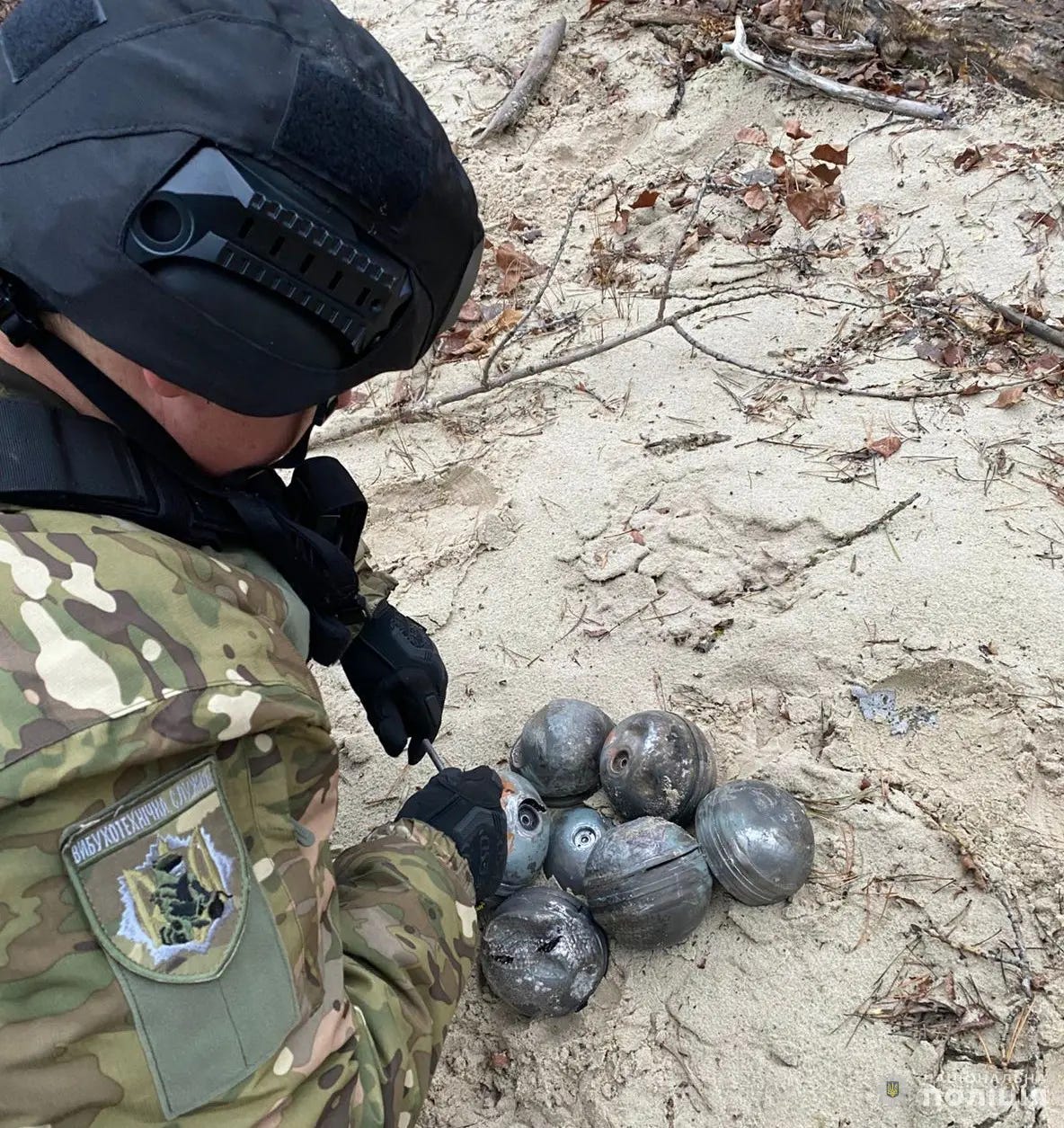
The United States has not used cluster munitions in combat since 2003, aside from a single reported strike in Yemen in 2009, and no U.S. company currently produces them. A 2008 Department of Defense directive phased out the use and transfer of cluster munitions with high failure rates. And a longstanding U.S. law restricts the export of cluster munitions with a failure rate above one percent and requires specification that the cluster munitions will not be used against civilians, subject to only an override by the President in exceptional circumstances. Against this backdrop, renewed procurement marks a notable departure from prior U.S. practice and from the broader trajectory of international norm crystallization.
At the same time, U.S. policy has grown increasingly inconsistent. The longstanding 2008 policy (adopted under George W. Bush in 2008 and continued by Barack Obama) was significantly relaxed in 2017 by President Trump, allowing continued use of existing stockpiles and transfer to replenish munitions. President Biden also waived the appropriations restriction at least seven times to enable the transfer of cluster munitions to Ukraine, drawing bipartisan criticism from Congress, other States, and the United Nations.
While these actions represent concerning backsliding in practices around stockpiling and transfer, the U.S. purchasing and seeking to produce cluster munitions for its own operations marks a troubling step toward renewed use.
Where Is Congress?
This episode reflects a broader pattern whereby the Executive branch plays a leading role in shaping—and at times weakening—international norms governing the conduct of war, often with limited legislative input despite relevant constitutional and Congressional authority.
Congress has several tools to respond to this procurement and to reassert its constitutional role and oversight function, especially with respect to the “power of the purse.” Other relevant constitutional authorities include Congress’ power to “make Rules for the Government and Regulation of the land and naval Forces” and to “define and punish… Offenses against the Law of Nations.” As far as transfers are concerned, the Foreign Commerce Clause assigns to Congress the authority to regulate exports from the United States.
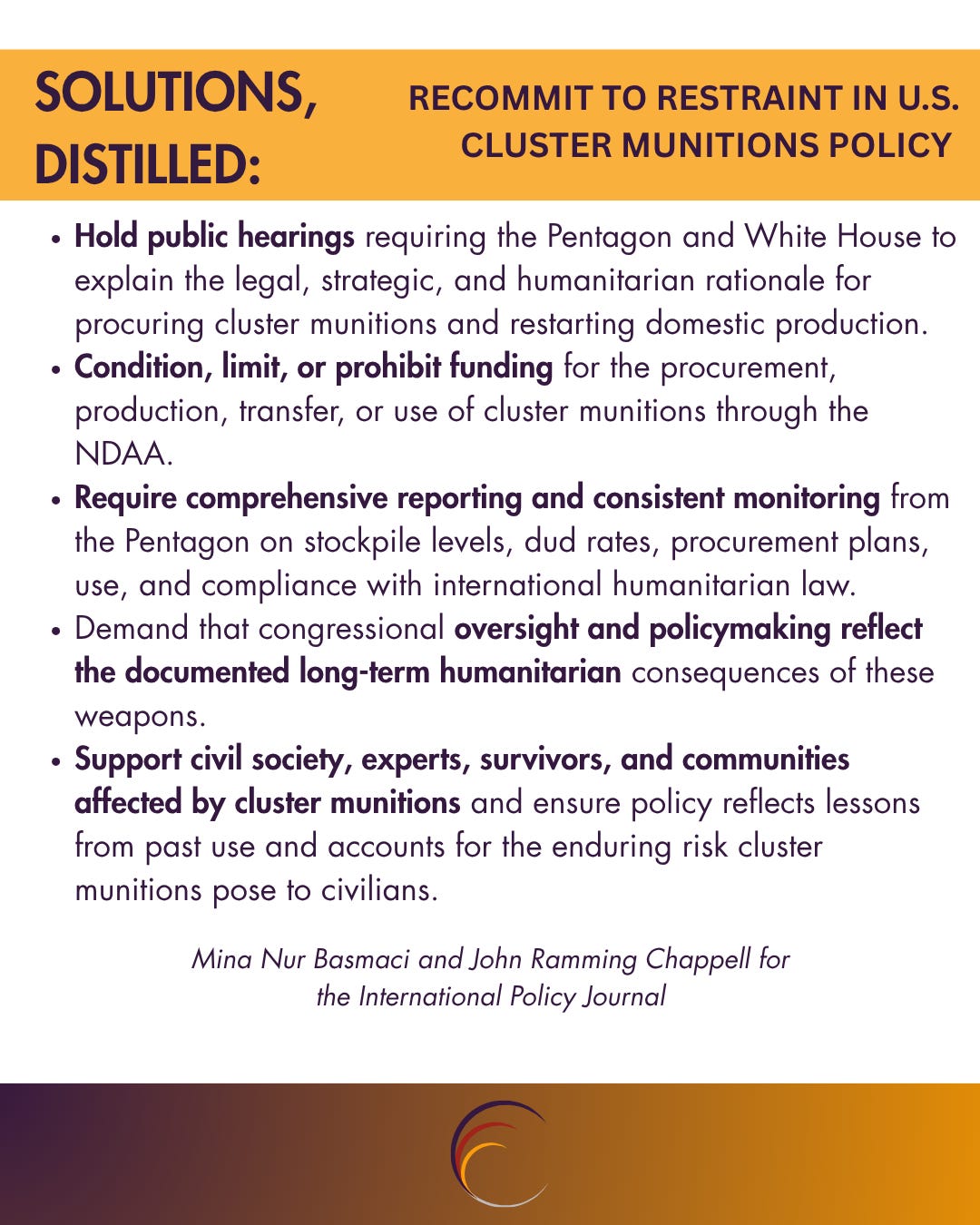
When it comes to cluster munitions, Congress can convene hearings and oversight inquiries. It may also impose conditions through the annual National Defense Authorization Act (NDAA) or appropriations legislation, which may include requirements for reporting or limitations on the use and transfer of cluster munitions. Rep. Sara Jacobs (CA-51) has led amendments to the NDAA aiming to restrict cluster munitions transfers in recent years.
In exercising its authorities, Congress should focus on increasing transparency around the rationale and implications of cluster munition procurement and use, and determine how the Department of Defense is assessing compliance with international humanitarian law and our commitments under the EWIPA framework. It should also seek information on stockpile management, ascertain the dud rates of cluster munitions in U.S. possession, and exercise scrutiny over further entrenching a partnership with Israel, which is credibly accused of gross human rights violations. Irrespective of passage, these measures serve important record-building interests and reinforce Congress’ authority in this space.
Absent meaningful congressional engagement, this procurement risks further enabling an Executive branch that has undermined and politicized international legal norms.
Consequences far beyond the battlefield
Taken together, the Department of Defense’s recent procurement and market survey represents a clear regression from prior U.S. policy commitments and normative leadership and undermines broader international efforts to protect civilians. Specifically, the policy shift risks alienating key NATO allies, many of whom are legally bound under the CCM. By moving in a direction that diverges from allies’ legal obligations and political commitments, the United States may introduce friction within alliance coordination and operations and weaken its credibility and role. For example, when the U.S. transferred cluster munitions to Ukraine via Germany, Germany violated its obligations under the CCM to not allow transshipment of cluster munitions.
More broadly, the move contributes to an erosion of the emerging norm against cluster munition use. Norms of restraint are sustained not only through formal legal obligations but through consistent practice. When leading military powers signal renewed reliance on controversial weapons, it lowers the political and reputational costs for others to do the same. Lithuania’s 2025 withdrawal from the CCM—citing security concerns related to Russia—illustrates how quickly such norms can come under pressure absent a robust, mutually accountable, shared-values based approach rooted in respect for international humanitarian law.
Concerning also is the brazen inconsistency in how cluster munitions are regarded. This article has already mentioned Admiral Cooper’s comments concerning the legality of Iran’s use of cluster munitions against Israel. Similarly, States have widely condemned Russia’s use of cluster munitions against Ukraine. The U.S. Ambassador to the United Nations, Linda Thomas-Greenfield, has said to Russia that cluster munitions “have no place on the battlefield.” Yet the U.S. supplied cluster munitions to Ukraine, which have been deployed on the front lines, and it is now pursuing further procurement apparently for its own use. This contradiction risks undermining the credibility of legal norms and invites accusations of selective enforcement and lawfare. A consistent application of principles is essential—not only for maintaining legitimacy, but for ensuring the strongest possible protection of civilians in conflict.
Perilous next steps
Ultimately, the Department of Defense’s recent purchase and market survey is a quiet deal with loud consequences. It signals a potential renewed reliance by the U.S. on a weapons type widely regarded as among the most harmful to civilians, and risks deepening fractures with allies and weakening emerging norms designed to protect civilian populations. And when America sneezes, the world catches a cold; these actions may encourage similar backsliding by other countries.
Most importantly, the decision carries human consequences that extend far beyond the battlefield. Long after conflicts end, unexploded submunitions remain embedded in fields, villages, and cities, continuing to injure and kill civilians, especially children.
It is too early to know whether and how the U.S. will put its procurement to use. But to maintain the norm against the use, transfer, and stockpiling of cluster munitions, States, civil society, and Congress must use their influence to oppose and scrutinize U.S. actions and enforce the norm.
Mina Nur Basmaci is a former Advocacy & Legal Fellow at Center for Civilians in Conflict (CIVIC). John Ramming Chappell is an Advocacy & Legal Advisor at Center for Civilians in Conflict (CIVIC).