Arms Without Leverage: Rethinking US Security Assistance to South Asia
The types of weapons sold by the United States shape its relationships with other countries, and how partners manage crisis together.

In November 2025, the US State Department approved a $93 million arms sale to India that included Javelin anti-tank missile systems and Excalibur precision-guided artillery munitions. While the deal is a relatively modest one in financial terms, it reveals the evolution of Washington’s security assistance strategy in South Asia.
This Foreign Military Sales (FMS) package is designed to enhance India’s precision strike capabilities and battlefield effectiveness, while reinforcing interoperability with US-origin systems already in service, such as the M777 howitzer. Unlike earlier high-profile deals focused on major platforms — maritime patrol aircraft, helicopters, or transport fleets — this sale prioritizes precision, integration, and sustainment, signaling a strategic shift in US thinking about how best to support India’s military modernization.
The timing of the sale is equally important. It comes after both signed the 2025 Framework for the US-India Major Defense Partnership and amid a broader push by Washington to deepen defense ties with India as part of its Indo-Pacific strategy, even as political frictions persist over trade, India’s relationship with Russia, and “strategic autonomy.” US officials framed the deal as supporting India’s role as a “major defense partner” and contributing to regional stability, especially in regard to countering China.
The US has also signed a new $686 million package arms sales deal with Pakistan that the US Defense Security Cooperation Agency approved in December 2025, and which is almost entirely focused on upgrading and sustaining Pakistan’s F-16 fighter jet fleet rather than providing new weapons systems. The inclusion of Link-16 enhances coordination with US and allied forces, particularly in joint operations and counterterrorism missions. Washington emphasized that the deal with Pakistan would not alter the region’s balance, where India maintains its military muscle.
Globally, the United States remains the dominant arms exporter, accounting for roughly 42 percent of total global arms exports in 2021–25, far ahead of competitors. This dominance gives Washington unmatched leverage — but that leverage is unevenly distributed across regions. South Asia is not the largest destination for US arms, but it is among the most strategically sensitive. Asia and Oceania account for roughly one-third of global arms transfers, with India and Pakistan consistently among the top importers. India alone has remained one of the world’s largest arms importers for decades, while Pakistan’s imports have surged in recent years. Data from the Security Assistance Monitor (SAM) at the Center for International Policy, which tracks US security assistance dating back to 2000, complements this picture. SAM data demonstrates that US involvement in South Asia extends beyond major weapons systems to include FMS, Foreign Military Financing (FMF), training programs, and counterterrorism assistance. This broader ecosystem of assistance matters because it fosters relationships, builds interoperability, and shapes the military doctrines of both India and Pakistan.
Yet, what does the United States want to achieve by these arms sales to India and Pakistan? SAM data reveals a pattern: US arms sales are not simply about equipping India and Pakistan, but also influencing the regional order. However, India’s diversification and Pakistan’s pivot to China indicate that US influence through arms transfers is constrained, as it cannot change either state’s behavior. To remain relevant, US policy must shift from transactional arms sales to a more integrated approach that prioritizes systems, crisis management, and political strategy.
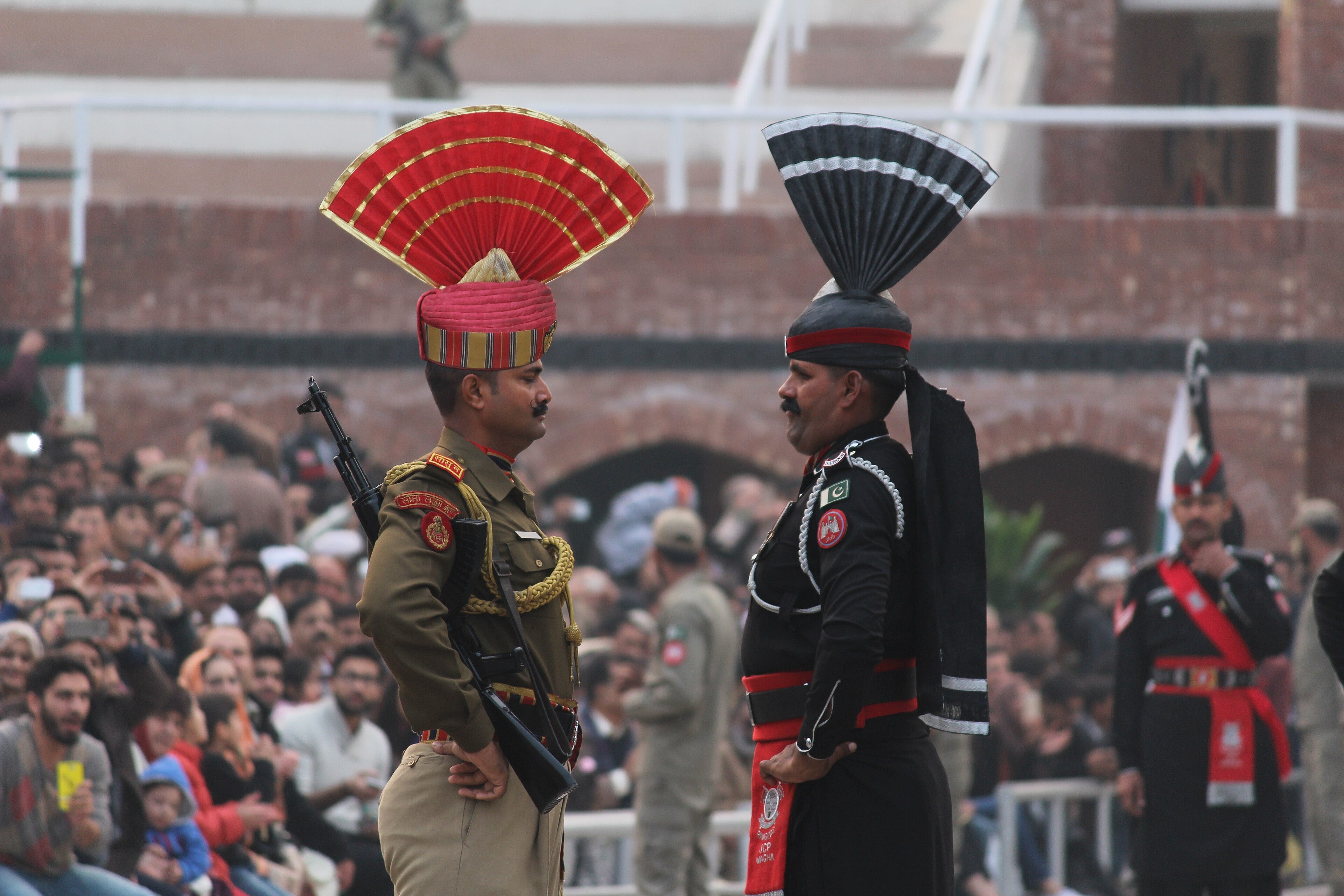
India: The Selective Customer
The US–India defense relationship transformed dramatically since the early 2000s. Arms transfers outline the shape of this shift, but they do not tell the whole story.
US arms sales to India are best understood in terms of the capabilities they enable rather than the platforms themselves. From SAM Data, across maritime, air, and land domains, US transfers strengthened India’s maritime surveillance and anti-submarine warfare capabilities through systems such as the P-8I and naval helicopters, while also enhancing precision-strike capabilities with guided munitions such as Excalibur artillery rounds and Javelin missiles. At the same time, heavy-lift aircraft such as the C-17 and C-130 expanded India’s strategic mobility and logistics reach, particularly for high-altitude and rapid-deployment operations. More recent acquisitions—including drones and data-linked systems—underscore a shift toward networked warfare, where sensors, shooters, and decision-making are increasingly integrated in real time. Taken together, these sales indicate that the United States is not simply supplying hardware but helping India build a more integrated force.
Yet, India remains a selective buyer, not a dependent client. Historically, Russia has been India’s greatest supplier of arms, a persistent thorn in US–India defense relationships across administrations. Despite increasing diversification among suppliers and growing US sales — including transport aircraft, helicopters, and surveillance platforms — Russia continues to supply the most arms to India, followed by France and Israel. The efforts at diversification reflect a deliberate strategy rooted in strategic autonomy. India has reduced its reliance on Russia—from roughly 70 percent of imports in the early 2010s to around 40 percent more recently—but has not replaced that dependence with a US monopoly. Instead, it has created a multi-vendor procurement model.
For Washington, this creates both opportunity and limitation. Arms sales remain a key pillar of the broader strategic partnership, reinforcing initiatives such as interoperability agreements and maritime cooperation. Yet, the US cannot fully shape India’s military posture through arms transfers alone. Also, focusing only on the mix of arms suppliers overlooks the other dominant trend governing India’s military spending. India’s growing domestic defense industry is gradually reducing its reliance on imports altogether. This trend suggests that US arms sales to India may plateau—not because of political friction, but because of structural shifts in India’s defense economy.
Pakistan: The Uncertain Partner
SAM data highlights the cyclical nature of US assistance to Pakistan. In recent years, US arms transfers to Pakistan increasingly focused on maintenance, sustainment, and counterterrorism, rather than new high-end capabilities. During the post-9/11 period, Pakistan was a major recipient of US military aid, including aircraft, helicopters, and counterterrorism support. However, since the mid-2010s, US assistance has declined sharply, reflecting growing mistrust and shifting priorities. Two incidents in 2011 forced Washington to view Pakistan through a critical lens, especially in the realm of counterterrorism: the raid in Abbottabad that killed Osama bin Laden and the Salala incident where NATO airstrikes killed Pakistani soldiers near the Afghanistan border. In addition to these high-profile incidents, the formal conclusion of Operation Enduring Freedom in 2014, the US combat mission in Afghanistan, reduced the strategic rationale for expensive military aid to Pakistan. The Resolute Support Mission, which succeeded Enduring Freedom, simply did not have the capacity to provide Pakistan with a high level of US military aid.
Figure: Deliveries of US Arms To Pakistan, 2009 – 2017
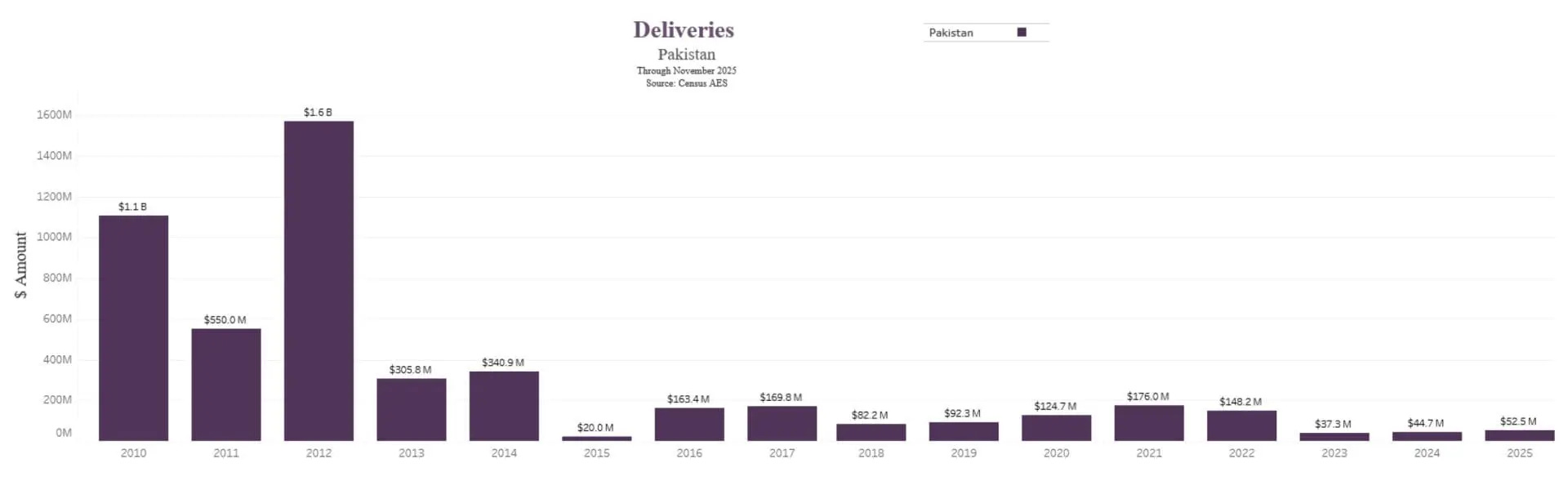
Source: SAM
The relationship also drew negative political attention, prompting pushback from Members of Congress. In May 2016, a State Department spokesperson cited congressional opposition as the main reason why the Obama administration had decided not to provide FMF, or in other words, US taxpayer-provided money, to Pakistan for purchasing F-16s. Instead, the US welcomed Pakistan to raise its own funds for the jets. Since Pakistan was unable to raise the funds, the deal was eventually scuttled.
As US security assistance waned, Pakistan deepened its defense relationship with China, which now accounts for roughly 80 percent of its arms imports. Pakistan’s Chinese-supplied arsenal emphasizes advanced airpower and air combat dominance, anchored by platforms like the JF-17 (jointly developed) and J-10C fighters, along with long-range air-to-air missiles and supporting radar systems. These are complemented by integrated air defense capabilities, including systems like the HQ-9 and LY-80 surface-to-air missiles, which provide layered protection against aircraft and drones. China also significantly strengthened Pakistan’s naval and maritime warfare capabilities, including the transfer of modern frigates (such as Type 054A vessels) and submarine technologies, enabling better sea control and anti-access operations in the Arabian Sea.
The result is a bifurcated regional landscape. The United States is a major—but not dominant—supplier to India, and a declining—though still relevant—supplier to Pakistan. China, by contrast, is becoming Pakistan’s primary external defense partner, reinforcing a broader geopolitical alignment.
How Arms Transfers Fuel the India–Pakistan Rivalry
The most enduring driver of arms transfers in South Asia remains the India–Pakistan rivalry. Stockholm International Peace Research Institute (SIPRI) data consistently identifies both countries among the world’s largest arms importers, with their competition serving as a central driver of regional militarization. US arms sales have played a complex role in this dynamic. On one level, Washington has sought to maintain a degree of balance, historically supplying both India and Pakistan at different times. On another level, US policy has increasingly tilted toward India, reflecting broader Indo-Pacific priorities.
Figure: Comparison of US Arms Sales Capabilities: India vs. Pakistan
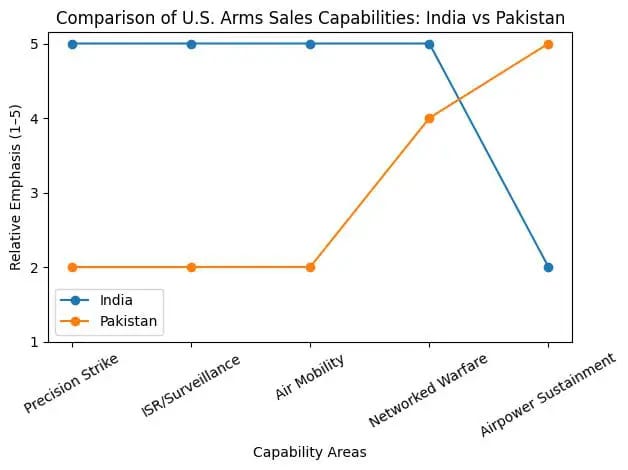
This shift has implications for strategic stability. While US arms transfers to India are often framed as part of a broader effort to counter China, they inevitably affect the India–Pakistan balance as well. Pakistan, in turn, responds through its own procurement — largely from China — creating a triangular arms dynamic. The nature of the arms transfers also matters. As the May 2025 crisis indicated, modern warfare is focused on networks, long-range precision-strike capabilities, and airpower integration, as well as beyond-visual-range engagement. These trends suggest that arms transfers are no longer about platforms alone but about systems integration — something that US assistance is particularly well-suited to provide.
Compared to China and other major sellers, US arms transfers come with end-use monitoring, congressional oversight, and political expectations attached to security assistance. While these tools often fall short of meaningful restraint, they nonetheless introduce political considerations into the transfer process. Also, unlike private defense firms in the United States that remain institutionally separate from the state, and where US arms manufacturers compete for the same contracts, Chinese firms operate within a political framework that allows the state to direct or integrate commercial innovation into national security objectives. As a result, Pakistan is not simply buying weapons from China but is becoming integrated into China’s technology architecture, which could accelerate elements like military adaptation, networked warfare, and AI-enabled decision-making in future crises with India. This also complicates traditional confidence-building measures in South Asia, which were designed around visible state-controlled military systems rather than commercially enabled, dual-use technologies.
At the strategic level, US arms transfers operate within the constraints of nuclear deterrence. Both India and Pakistan possess nuclear weapons, and their rivalry is structured around mutual vulnerability, which relies on two presuppositions. First, conventional arms transfers do not fundamentally alter the deterrence balance. They may shift tactical or operational dynamics, but they do not change the underlying strategic equilibrium. The US Arms Export Control Act acknowledges the role that conventional arms transfers can play in overall stability by requiring that export control decisions “take into account whether the export of an article would contribute to an arms race, aid in the development of weapons of mass destruction…or prejudice the development of bilateral or multilateral arms control or nonproliferation agreements.”
The second assumption of US deterrence policy is that external actors have a limited ability to shape escalation pathways. The most critical decisions in a crisis — whether to escalate, de-escalate, or signal restraint — are made in New Delhi and Islamabad, not Washington or Beijing. SAM data reinforces this point indirectly. It shows that arms transfers fluctuate with political relationships, but regional crises persist regardless of those fluctuations. In other words, arms sales are not a stabilizing force in themselves.
Policy Prescriptions: From Transactions to Strategy
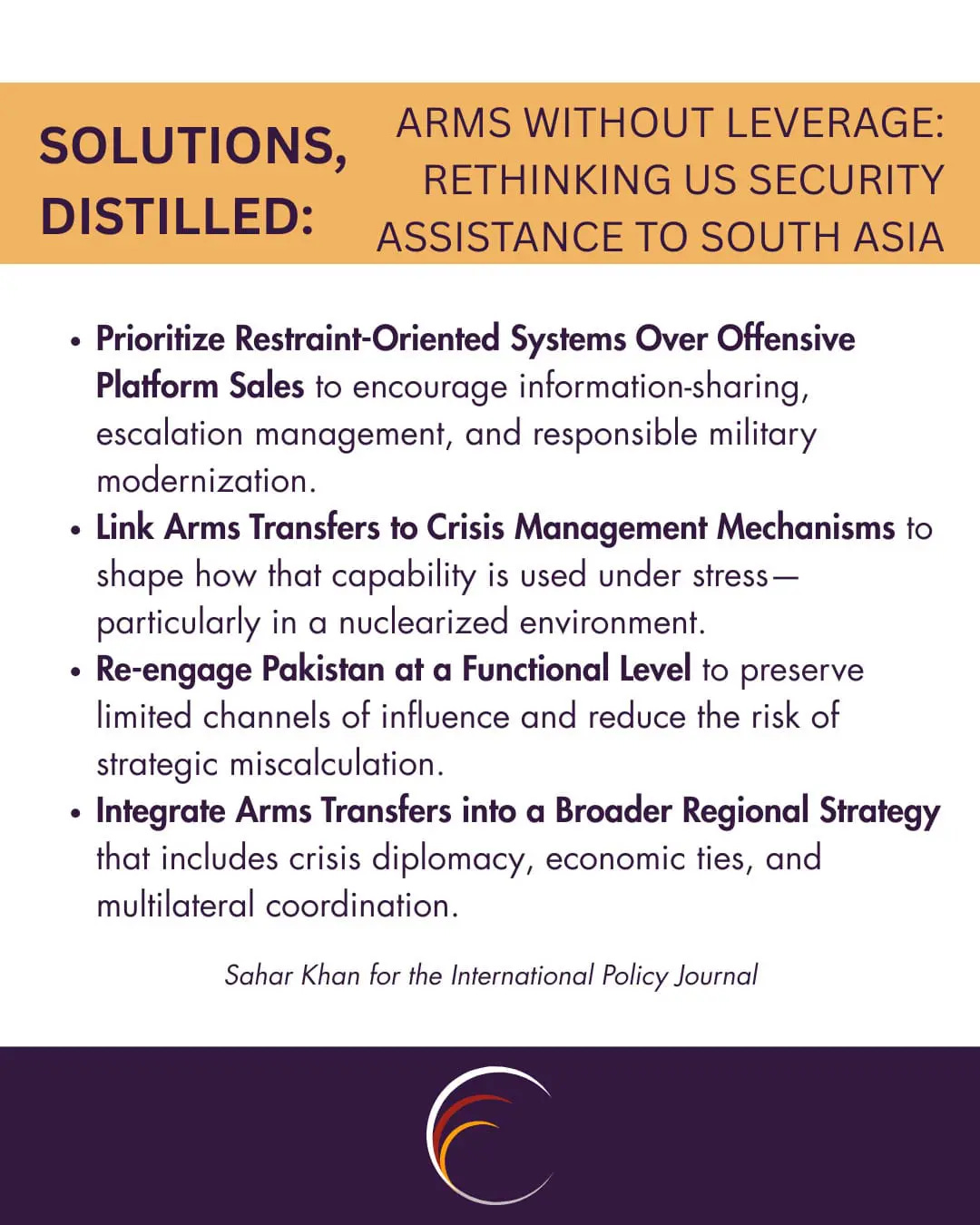
If US arms transfers to South Asia generate access but not control, the policy challenge is to convert access into meaningful strategic impact. Four concrete steps can help achieve this shift.
Prioritize Restraint-Oriented Systems Over Offensive Platform Sales: Rather than emphasizing additional platform sales that risk fueling regional arms competition, US policy should focus on capabilities that enhance transparency, situational awareness, and crisis management, such as ISR, maritime domain awareness, secure communications, and data-sharing architectures. These systems align with the evolving character of warfare while also supporting restraint by improving early warning, reducing uncertainty, and strengthening command-and-control reliability during crises. Instead of measuring influence through the volume of hardware transferred, Washington should prioritize embedding itself within partner militaries’ operational networks in ways that encourage information-sharing, escalation management, and responsible military modernization.
Link Arms Transfers to Crisis Management Mechanisms: Arms sales should be tied to the development and reinforcement of crisis management tools. This includes supporting nuclear confidence-building measures that are already in place, such as missile pre-notification agreements, strengthening military hotlines, and conducting joint simulations. The goal is not just to enhance capability, but to shape how that capability is used under stress—particularly in a nuclearized environment.
Re-engage Pakistan at a Functional Level: While a full restoration of US–Pakistan defense ties is unlikely, a complete disengagement is strategically counterproductive. The United States should maintain targeted cooperation in areas such as aviation safety, disaster response, and nuclear risk reduction. This approach will not reverse Pakistan’s alignment with China, but it can preserve limited channels of influence and reduce the risk of strategic miscalculation.
Integrate Arms Transfers into a Broader Regional Strategy: Finally, US arms sales must be embedded within a broader political and diplomatic strategy for South Asia. Defense cooperation with India cannot substitute for regional engagement that includes crisis diplomacy, economic ties, and multilateral coordination. In other words, arms transfers should support—not substitute for—a coherent regional policy.
Arms and Ends
US arms sales and transfers to South Asia are best understood not as a standalone policy tool, but as part of a broader strategic framework. They are used to build partnerships, signal commitment, and shape regional dynamics, but they cannot, on their own, determine outcomes.
SAM data underscores this point. It shows that US security assistance is deeply embedded in political relationships and that its effectiveness depends on alignment, trust, and shared strategic objectives. In South Asia, those conditions are uneven. India is a partner but not an ally while Pakistan is a partner of convenience, increasingly aligned elsewhere. Both countries are nuclear-armed, domestically capable, and strategically autonomous.
For US policymakers, the lesson is not that arms sales are irrelevant, but that they are insufficient. Used wisely, they can reinforce relationships, enhance interoperability, and support stability. Used in isolation, they risk becoming an expensive substitute for strategy. In South Asia’s nuclearized and increasingly multipolar landscape, the United States must move beyond the illusion that arms transfers alone can deliver influence. The challenge is not to sell more, but to think more strategically about what those sales are meant to achieve.
Sahar Khan is a 2026 nonresident fellow at the Institute of Global Affairs and a co-host of a new podcast focused on South Asia in the new nuclear age called “Beyond the Lines of Control.” Previously, she served as the deputy director and senior fellow of the South Asia program at the Stimson Center, a research fellow in Defense and Foreign Policy at the Cato Institute, and managing editor of Inkstick Media. Her research focuses on restraint, deterrence, and South Asian regional security and politics.